

The Algarve is not uniformly step-free, but several destinations have documented accessible routes, accessible beaches or adapted visitor facilities. This guide focuses on what a visitor can expect at each location, including the surfaces, entrances, routes and equipment that are specifically identified by tourism authorities. Facilities can still change seasonally, so the details below should be treated as practical planning information rather than a guarantee for every wheelchair or scooter user.
1. Faro: The strongest all-round base for accessible sightseeing
Faro is one of the best starting points for an accessible Algarve itinerary because the official accessible route is clearly defined around Jardim Manuel Bívar, the marina, Baixa de Faro and the historic centre. Jardim Manuel Bívar has regular pavements, open terraces and space to pause beside the recreational port. The tourist train that departs from the square is adapted for people with reduced mobility, and the advertised circuit lasts approximately 50 minutes.
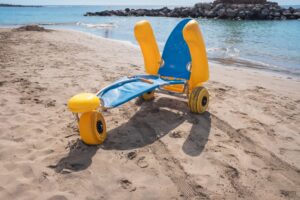
The recreational port has an accessible area with unobstructed circulation. Faro also provides a particularly useful beach option: Praia de Faro-Mar is identified as an Accessible Beach and is described as having amphibious wheelchairs for entering the water. This makes it a more realistic choice for a beach day than simply choosing the nearest sandy beach.
The limitations are concentrated in the old town and individual businesses. Portuguese paving in the main pedestrian streets is generally regular and level, but some restaurant and shop entrances have steps.
The route towards São Pedro and Igreja do Carmo is not fully accessible and may be better approached using an adapted vehicle. For a practical day, base the visit around Jardim Manuel Bívar, the marina and the accessible tourist train, then add only pre-checked historic attractions.
2. Ria Formosa: Accessible lagoon scenery, but boat access varies
The Ria Formosa is a good option for visitors who want nature rather than steep cliff paths. From Faro, the accessible-tour guidance identifies the lagoon and recreational port as part of the city route, and local tourism operators offer boat trips aimed at people with reduced mobility. The most useful question is not simply whether a boat tour is “accessible”, but whether the specific vessel has a ramp, level boarding, an accessible toilet and room for the person’s chair or scooter.
On land, choose a boardwalk, viewpoint or visitor area with a firm surface and a short distance from accessible parking. The lagoon is tidal, so a route that is comfortable at one point in the day may not provide the same beach or jetty experience later. A private or small-group accessible boat is likely to offer more practical flexibility than assuming every scheduled excursion has the same boarding arrangement.
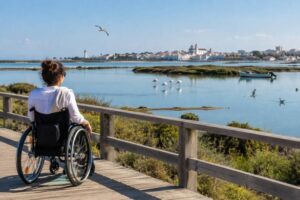
Ria Formosa scenery from an accessible boardwalk. Generated editorial image for Strive Mobility.
3. Vilamoura Marina and the route towards Quarteira
Vilamoura Marina is one of the easier places in the central Algarve for a level waterfront outing. The marina area has broad pedestrian routes, restaurants and places to stop without needing to negotiate the steep streets found in some older resort towns. A practical itinerary is to stay around the marina basin, where the main challenge is usually the distance rather than steps.
Accessibility is also recorded at individual businesses. For example, the VisitPortugal listing for the Voyage Restaurant at Tivoli Marina Vilamoura describes an accessible entrance, reserved parking, accessible circulation, an accessible buffet area, accessible toilets and accessible patio areas. This is the level of detail readers should look for when choosing restaurants.
The promenade connection towards Quarteira can be a useful longer route, but mobility-scooter users should check the exact surface, rest points and return distance before setting out. The marina is the safer choice for a short, predictable outing; the longer promenade works better when the user has enough battery range and a transport backup.
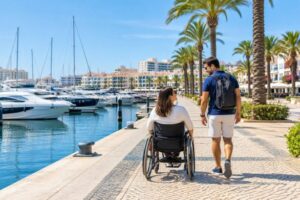
A level marina promenade in Vilamoura. Generated editorial image for Strive Mobility.
4. Albufeira: Choose the accessible beach route, not the old-town shortcut
Albufeira can be enjoyable for an accessible beach day, but its older streets and resort slopes make route selection important. The historic centre is not a reliable step-free environment, and a route that looks short on a map may include a sharp gradient, cobbled paving or an entrance with steps. A wheelchair user or scooter user will usually have a more predictable experience by arranging a drop-off close to the promenade or an officially designated accessible beach entrance.
Portugal’s Accessible Beach programme identifies participating beaches with a white flag bearing the blue-and-yellow Accessible Beach symbol. The standard includes reserved parking, a pedestrian route to the beach, beach walkways and adapted toilet facilities. Some beaches also provide amphibious chairs. In Albufeira, use the official beach list and the specific beach’s current facilities rather than assuming that every beach in the municipality offers the same equipment.
For accommodation, the most useful base is usually one with step-free access to the pool, restaurant and street-level transport. That avoids making the old town’s slopes part of every daily journey.
5. Lagos: Accessible rail arrival and a manageable waterfront base
Lagos has one of the clearest transport advantages in the region. The Lagos railway station is described in the official accessible-tour information as having an accessible entrance, adapted toilets, spacious indoor areas and audible and visual information systems on the platforms. That makes rail arrival more realistic for travellers who arrange assistance in advance.
Once in Lagos, the marina and waterfront provide a more manageable base than attempting every historic street. The town’s older areas still include uneven paving and changes in level, so plan a route around the exact attraction rather than treating the whole centre as accessible. For beach visits, identify the accessible route from parking or drop-off to the sand, then check whether beach walkways and amphibious equipment are operating on the date of travel.
Lagos is a good choice for visitors who want a mix of accessible transport, waterfront scenery and short pre-planned outings. It is less suitable for an unplanned day of exploring every narrow historic lane.
6. Portimão, Praia da Rocha and Praia do Vau
Portimão offers some of the Algarve’s most practical beach options. Praia da Rocha has a developed promenade and tourism infrastructure, while Praia do Vau is specifically reported by Accessible Algarve as an Accessible Beach with an amphibious chair available for assisted access to the water. The facility is seasonal and assistance is required, so readers should check operating dates and beach staff arrangements before relying on it.
At either beach, distinguish between reaching the promenade and reaching the sea. A smooth promenade does not automatically mean that a wheelchair can cross the sand. Look for the Accessible Beach flag, a firm access walkway, adapted toilets and a beach wheelchair or amphibious chair. Nearby restaurants may still have steps, so the beach access information should be paired with a restaurant that states it has a level entrance and accessible toilet.
7. Tavira: Use the accessible riverside itinerary and avoid the castle slopes
Tavira is attractive but has a clear difference between its accessible and difficult areas. The official accessible route starts at Praça da República, described as a fully accessible space beside the River Gilão. From there, the old bridge is presented as an obstacle-free crossing, Jardim do Coreto is a flat and accessible riverside area, and Mercado da Ribeira is described as a wide, barrier-free venue containing shops, cafés and restaurants.
The route becomes harder near the castle. The streets around the castle are narrow, winding and uneven, and the historic centre includes steep slopes. Rather than promising that Tavira is wheelchair-friendly as a whole, the useful recommendation is to follow the riverside route and use the tourist train for a broader overview. For a beach extension, the official accessible-tour information identifies Praia do Barril as providing an amphibious chair. The boat or transfer route to Tavira Island should still be checked for boarding access.
Accessible beaches and coastal viewpoints
The Algarve’s Accessible Beach programme is the most useful region-wide starting point for selecting a beach. The official tourism information says that participating beaches have facilities designed to improve access and use by people with mobility limitations. National guidance describes the Accessible Beach symbol as covering reserved parking, pedestrian access, beach walkways and adapted toilets, with amphibious chairs available at some locations.
This means that the best beach choice is not necessarily the most famous beach. Select a beach with the symbol, then check the current season’s facilities, the slope from parking to the entrance, the length of the walkway, toilet location, shade and whether an amphibious chair is available. For coastal viewpoints, prioritise formal promenades and marked platforms. Many dramatic cliff viewpoints remain unsuitable because of steps, loose ground or unprotected edges.
Accessible accommodation in the Algarve
VisitPortugal lists adapted accommodation through its accessibility filters, but its own guidance recommends contacting the property directly about the exact facilities. Ask for the door width, turning space beside the bed, shower type, grab rails, shower chair, bed height, lift dimensions and step-free access to the restaurant, pool and parking. These details are more useful than the label “accessible room”.
For a first trip, Faro, Vilamoura, Portimão or Lagos can be practical bases because they combine accommodation, restaurants and transport or waterfront routes. A property near an accessible promenade may be more useful than a hotel advertised as close to a beach if the route between them includes a steep hill. Ask whether a mobility scooter can be stored and charged safely, and whether an adapted transfer can reach the entrance.
Are Algarve streets suitable for wheelchairs?
There is no single answer. Faro’s main pedestrian streets and Tavira’s riverside route include documented accessible sections, while historic areas around Faro’s churches and Tavira’s castle have restrictions. Marina promenades and newer resort areas are usually more predictable than old-town lanes. The practical rule is to plan named routes, not entire towns.
Do public transport services facilitate wheelchairs and mobility scooters?

The Algarve railway line connects Lagos, Portimão, Albufeira, Faro, Tavira and Vila Real de Santo António. CP (The Algarve Line) provides its Integrated Mobility Service, but wheelchair and mobility-scooter assistance is available only at stations included in CP’s designated station list. CP also states that some services require a transfer to a train wheelchair, with the passenger’s own wheelchair folded and stored, so travellers should check the exact train and boarding arrangement before buying a ticket.
Regional buses operate through VAMUS Algarve, but accessibility depends on the vehicle, route and boarding point. For a scooter, provide its dimensions and weight when asking about access. Where the route involves several changes, a pre-booked adapted transfer may be more dependable than assuming that every bus or taxi can carry the equipment.
Look specifically for the Accessible Beach symbol and its associated reserved parking. The programme is intended to provide a pedestrian route, beach walkways and adapted toilets, with amphibious chairs at some beaches. Coastal viewpoints without a marked accessible bay, firm route or level platform should be treated as scenic stops for companions, not assumed wheelchair destinations.
Accessible parking and drop-off points by location
Parking information is more variable than beach or attraction information, and many municipalities do not publish the exact bay number online. The points below identify the most practical named areas for an accessible arrival. A reserved bay is different from a general drop-off: the driver should confirm where the vehicle can stop safely, how far the route is to the entrance and whether a ramp or lift can be deployed.
Tavira
Praça da República is the most useful central drop-off for the documented accessible riverside route. Mercado da Ribeira provides another practical landmark because it is described as a wide, barrier-free venue. For Praia do Barril, use the mainland parking at Pedras d’El-Rei and confirm how the accessible visitor will reach the transfer or beach-access equipment before arrival, since the final connection is not simply a standard roadside drop-off.
Portimão and Praia da Rocha
For Praia do Vau, use the accessible beach parking and the signed route to the beach facilities, including the amphibious-chair service when operating. At Praia da Rocha, arrange a drop-off beside the promenade and confirm the exact kerb-free entrance with the accommodation or beach staff. Keep the vehicle out of pedestrian space and do not rely on cliff-top viewpoint parking as an accessible alternative.
Lagos
Lagos railway station is the clearest transport drop-off because its accessible entrance and adapted facilities are documented. For the waterfront, use the marina-side access or a hotel-arranged set-down close to the level promenade. At beaches, use only the signed accessible parking associated with the current beach-access equipment; do not assume the nearest general beach car park reaches the walkway.
Albufeira
Choose the car park attached to the participating Accessible Beach shown with the blue-and-yellow symbol, where reserved parking and a pedestrian route to the beach are part of the programme. For the old town, use a short-stay drop-off on the flatter road nearest the promenade rather than attempting the steepest historic-centre streets. Confirm that the driver can wait safely and that the route does not require crossing a kerb or cobbled slope.
Vilamoura
The marina car parks are the practical starting point for the level waterfront route. Ask the marina, hotel or restaurant to reserve an accessible bay or identify the closest level entrance. For the longer route towards Quarteira, arrange a return pick-up point at the marina or a pre-agreed promenade access point, because battery range and rest points can be more important than the initial parking space.
Faro
Jardim Manuel Bívar is the most useful central drop-off point for the accessible city route, with the marina and Baixa nearby. For a beach day, use the signed accessible parking serving Praia de Faro-Mar, then follow the accessible route to the beach facilities. Avoid using the old-town church area as a general drop-off because parts of the route are restricted or uneven.
Practical booking checklist
- Use official Accessible Beach information to choose the beach, then verify the current season’s equipment.
- Save the exact route name, entrance and parking location, not just the attraction name.
- For CP trains, request mobility assistance and confirm that both stations are in the supported station list.
- Give transport providers the chair or scooter width, length, weight and whether it folds.
- Ask hotels for measurements and photographs of the bedroom, bathroom, lift and entrance.
- Plan one accessible primary route and one backup route for each day.
Conclusion
The Algarve is most accessible when the itinerary is built around documented routes: Faro’s marina and adapted tourist train, Tavira’s riverside circuit, Lagos station and waterfront, Vilamoura Marina, and beaches carrying the Accessible Beach symbol. These options do not remove every barrier, but they give travellers something much more useful than a general guide: a realistic idea of where they can go, what surfaces they will encounter and which facilities are specifically available.
For practical mobility guidance and accessible-travel support, visit Strive Mobility.
Research and publication note
Prepared and updated 17 October 2026 on behalf of Strive Mobility.
Key references consulted: VisitAlgarve, “Praias Acessíveis” and “Algarve Acessível”; Turismo de Portugal accessible tours for Faro, Lagos and Tavira; Turismo de Portugal guidance on Accessible Beaches, accommodation and public transport; CP information on the Algarve Line and the Integrated Mobility Service; VAMUS Algarve service information.
Beach equipment, station assistance, boat boarding and seasonal facilities should be reconfirmed before travel.